Vinyl Versus Hardie Board Siding

The importance of durable, long-lasting, and aesthetically pleasing house siding cannot be overstated. The materials and method of installation determine whether your home is properly insulated and if it can effectively resist moisture, wind, impact, and pests.

L&S Home Improvements has over 75 years of combined industry experience installing siding, and because of our expertise, we stand behind vinyl as the superior option. While vinyl and Hardie Board provide very similar resistance properties, Hardie won’t last as long, and it will cost homeowners more to install and maintain over time.
Vinyl Siding
Factor Vinyl Hardie Board
Impact Resistance Excellent Good
Wind Resistance Excellent Excellent
Fire Resistance Good Excellent
Temperature Resistance Excellent Excellent
Moisture Resistance Excellent Excellent
Pest Resistance Excellent Excellent
Cost $ $
Lifespan 50+ Years 30 Years
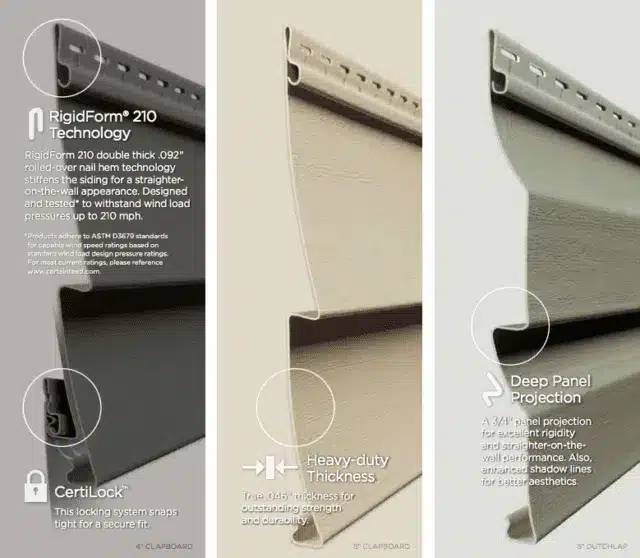
Installation Low. Vinyl is lightweight and easier to install. L&S Home Improvements specifically uses CertainTeed vinyl siding, which is designed with several features that make installation less complicated and more durable. Medium. Hardie Board is heavier than vinyl and more difficult to handle. The installation process also requires specialized tools and protective equipment.
Design Versatility High. Vinyl, especially CertainTeed products, come in numerous colors and styles, including their CERTAplank® style which mimics the appearance of Hardie Board. CertainTeed products also feature Permacolor™, a guarantee that the color won’t fade over time. Medium. Hardie Board comes in multiple colors and styles. Most available colors are neutral, but Hardie Board can be painted any color.
Maintenance Needs Low. Vinyl only needs yearly cleaning. High. Hardie Board will need to be painted and if any repair work is needed, it can be incredibly complex and impact the home’s overall aesthetic.
Energy Efficiency Varies based on insulation. L&S Home Improvements uses 1/4” or 1/2” rigid insulation with a Tyvek moisture barrier. Vinyl siding does not have high R-value on its own. Hardie Board does not offer high R-value. Similar to vinyl, the insulation used during the installation process will determine its overall energy efficiency.

Cost

The manufacturer/brand is a significant factor in determining the cost of both vinyl and Hardie siding. Hardie is a brand of fiber cement siding, and it’s slightly more expensive (around $10 to $20 per panel) than a premium vinyl brand like CertainTeed, which starts at $8 and runs up to $20 for their premium lines, such as Cedar Shake, which mimic the look of real cedar. However, there are different product grades that cost significantly less; they just won’t last as long. Beyond material costs, Hardie is more expensive to install because the process is more complex.

Hardie doesn’t just cost more upfront; it also costs more over time because repairs are more complicated and sometimes require replacing multiple panels. And, if you want to paint it, you’ll have the added cost of repainting it because the paint will fade or chip over time from constant exposure to rain and UV rays.
upfront costs
reinforced foam backer

Weather Resistance

Weather must be accounted for when planning any exterior home improvement project, and hot summers, frigid winters, high wind events, and hail storms are all severe weather concerns for Michigan homeowners.

Although both vinyl and Hardie handle the Michigan weather well, temperature fluctuations favor vinyl siding. Hardie is composed of fiber cement, a porous material that can degrade after undergoing many freeze-thaw cycles. Hardie panels absorb moisture from humidity, rain, and temperature changes, causing them to expand and contract. Eventually, homeowners may see cupping or lifting around the fasteners, which comprises its overall integrity.

Another issue with Hardie is that it’s not as flexible as vinyl siding. When subjected to impact, it can fail (via fracturing or chipping) because it has very limited ability to deform plastically. Vinyl can move and realign under stress, bending rather than breaking. For homeowners, having siding that can withstand hail impact is critical. Once a crack appears in fiber cement, it can worsen quickly, and temperature can worsen these cracks. Additionally, Hardie has to be cut, and those cut edges create stress concentration points where chips are more likely to appear.

Longevity

When selecting a vinyl siding or Hardie board material, its life expectancy is primarily determined by the manufacturing process. A premium Hardie product could last longer than a cheap vinyl siding. But when you compare apples to apples, vinyl typically outlasts Hardie siding, especially CertainTeed’s premier vinyl options.

Well-maintained vinyl siding can last for upwards of 50 years, even in the harsh Michigan climate. You can also receive original-owner lifetime warranties. Hardie board warranties hover around 30 years, and their warranties won’t cover damage caused by hail. Comparatively, CertainTeed warranties do cover hail damage, provided the homeowner submits a claim to their insurance company, and the cost of repair or replacement exceeds the insurer’s payment.

Additionally, CertainTeed vinyl siding is created with pre-made slots, allowing each board to interlock with those beside it. By contrast, Hardie requires drilling holes and inserting fasteners. Needless to say, the fasteners are more likely to falter than interlocking materials.
Longevity
Maintenance & Repairs

Maintenance & Repairs

Vinyl siding ranks among the most straightforward types of siding to install, maintain, and repair. The boards interlock and can be easily removed if an incident damages one of them.

Hardie siding, on the other hand, requires extensive labor. A damaged or deteriorating board usually needs to be cut out. The repair specialist must also create a matching piece, as each fiber cement product will have different impression marks or castings, resulting in varying surface finishes and board thicknesses. Then, the specialist must drill new holes and attach and secure the panels in place. Caulk and sealants must also be applied to ensure moisture doesn’t get behind the patch job.

In terms of ongoing maintenance, vinyl, including CertainTeed’s CERTAplank®, which mimics the look of Hardie siding, requires only annual pressure washing/cleaning to remove algae, dirt, and other contaminants. Hardie board also requires yearly cleaning for the same reasons, but if it’s been painted, you’ll have to get it repainted every few years when it inevitably chips or fades. While exterior painting sounds easy, it’s anything but. If mistakes are made during the process, such as ignoring clearly damaged panels, forgetting primer, or not applying enough coats of paint, the results won’t last as long, and house painting companies can and will charge thousands of dollars. When considering Hardie, be aware that painting or repainting is a significant hidden cost.
Design & Color Options

Bold is not a word that describes Hardie siding. Its palette leans toward neutral colors, from tan to gray, with a few dull greens and blues thrown into the mix. Bold can still be an option for homeowners, though, as Hardie board can be painted. Please keep in mind the additional costs associated with painting, as some contractors may not offer both installation and painting as a single service. Additionally, repainting will be an ongoing maintenance task that requires attention every few years.

Vinyl siding manufacturers have been ahead of the color curve for quite a while. Homeowners can order neutral, bold, earthy, vibrant, and customized blends that augment your home’s exterior design. Plus, premier manufacturers like CertainTeed offer PermaColor technology, which ensures that the color you choose will last for years to come. If you like the look of Hardie but don’t want the associated maintenance, try CertainTeed's CERTAplank® product, which looks like Hardie board and is available in 15 colors, ranging from Castle Stone to Midnight Blue.
Design & Color Options
Installation Requirements

Installation Requirements

Comparing installation between vinyl and Hardie is like night and day. Vinyl is lightweight and less labor-intensive than Hardie. CertainTeed helps contractors by providing features like STUDfinder™, SureStop™, EasyMeasure™, Panel Thermometer™, and HammerTapper™ that prevent damage and ensure a longer-lasting installation.

Hardie is made from fiber cement, which makes it heavy. Its weight not only means more labor is required to hold each board in place but also is a significant risk if homes don’t have the structural support to handle the added weight. Contractors must also use diamond-tipped blades to cut them to size, creating silica dust, which is incredibly dangerous to inhale.

During the cutting process, there’s also little room for error. Specialized cutting techniques (not standard wood-cutting methods) are needed to prevent chipping. Contractors must also use specialized fastening techniques; over-driving them can create dimples that collect water and weaken the board, while under-driving means the board isn’t properly seated. Specific fastener types and pre-drilling are also necessary to prevent splitting, whereas vinyl siding features a simple snap-lock system. Additionally, precise gap requirements must be maintained to prevent moisture intrusion, and the exact spacing will vary depending on the climate zone and installation conditions.

All of these unique challenges result in a much slower installation process. In fact, Hardie takes about twice as long to install compared to vinyl. If homeowners also need fascia and soffit installed and the panels painted, more contractors will need to be involved, further adding to the project timeline. And even if your chosen siding contractor offers exterior painting, there are still the added labor costs to cover the painting.
CertainTeed | #1 Rated Brand Vinyl Siding Products By Building Professionals

Schedule a Consultation & Discover Why Vinyl Is the Superior Solution

L&S Home Improvements is proud to be a trusted roofing and siding contractor for homeowners throughout Oakland, Wayne, and Macomb counties. We’re committed to delivering long-lasting solutions, high-quality workmanship, and transparent customer service on every project. Schedule a free consultation with us today to discover why vinyl siding is the right solution for your home.
© 2026
L&S Home Improvements. All rights reserved.
Call Now
Free Quote