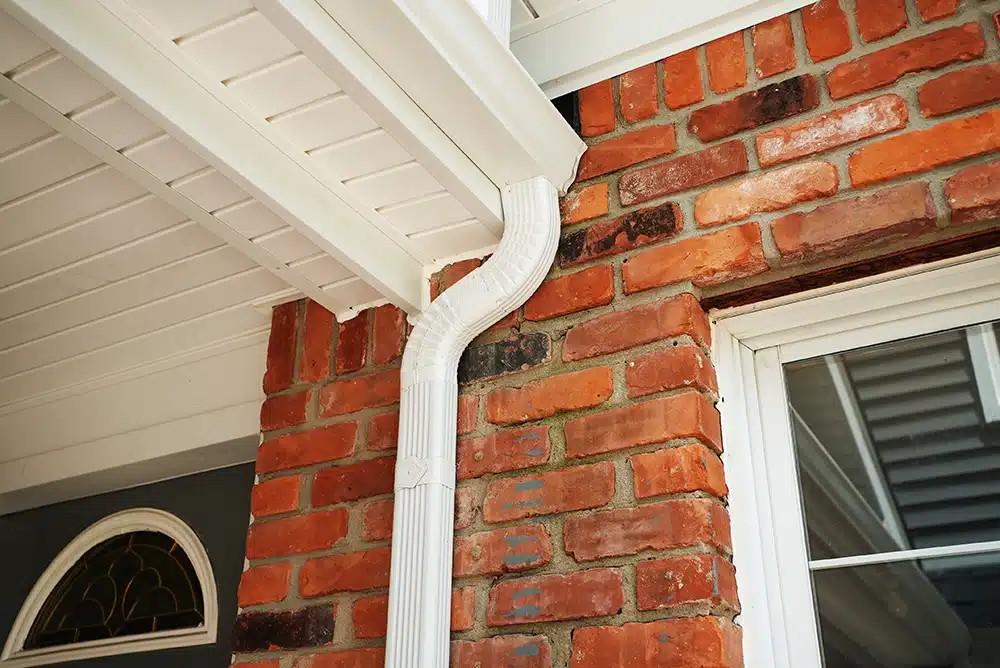
Gutters are critical components of roofing and drainage systems that control water runoff from your roof away from your property. Contrary to what many believe, gutters aren’t one-size-fits-all. You can undersize them, increasing water intrusion risk, or oversize them, which just means overspending.
Generally, most homes have 5- or 6-inch gutters, but the exact size you need varies based on these factors:
Roof Size
Larger roofs collect more rainfall, so you need a gutter system that can capture excess runoff without overflowing. For example, a 1-foot section of 5-inch gutter holds about 1.2 gallons of water. A 6-inch gutter of the same length holds about 2 gallons. That’s about a 40% difference in capacity.
As a general rule of thumb, choose 5-inch gutters if your roof footprint is under 1,500 square feet, you have a low-to-moderate roof pitch, and your gutter runs between downspouts are short. 6-inch gutters may work better if your roof footprint is over 1,500 square feet, the pitch is steep, and your system has longer runs (40 to 60 feet) between downspouts.
Roof Pitch
Roof pitch, or roof slope, measures how steep your roof is and is expressed as a ratio of vertical height increase (rise) to horizontal distance (run). Most residential roofs have pitches from 4:12 to 8:12, meaning for every 12 inches you move horizontally toward the center or ridge, the roof rises a specific number of inches. For instance, a 6:12 pitch means the roof rises 6 inches for every 12 inches of horizontal run.
So why is roof pitch so important? Because the slope largely dictates how quickly water runs off and enters the gutter system. Moderate-to-high-pitch roofs are steeper and shed rain quickly. Faster-moving runoff reaches gutters sooner and with more force than on low-pitch roofs, which take longer to drain.
Roofs with a pitch of 8:12 or greater should use larger 6-inch gutters to prevent water from spilling over the system as it runs down the roof, while homes with a lower roof pitch and less roof square footage can get by with standard 5-inch gutters.
Outlet Openings
Gutter size should also reflect downspout placement to ensure water runoff discharges safely and effectively away from the property. Standard 5-inch gutters typically pair with 2- to 3-inch downspouts, while 6-inch gutters usually pair with larger 4- to 5-inch downspouts.
Gutter run length is another factor when choosing the right size. Standard 5-inch gutters are ideal on properties with 30 to 35 feet of run between downspouts, while 6-inch gutters work better for sections that run 40 to 60 feet to ensure the system can handle the water volume between discharges.
Rainfall
Michigan averages about 30 to 33 inches of annual rainfall, with storms delivering peak rainfall of about 2.3 inches per hour. While weather and peak rainfall affect gutter size, 5- and 6-inch gutters are generally sufficient for most residential homes in Southeast Michigan. In other words, don’t base your gutter size primarily on the local climate; focus more on roof pitch and size. Gutters can be as big as 8 inches, but those bigger sizes are typically reserved for larger, commercial properties.
Your Drainage System Is More Than Your Gutters
While your gutters matter, they’re just one component of your drainage system. Other components matter just as much and can impact the entire system if they’re sized incorrectly, poorly installed, or damaged.
- Downspouts: These channel water from the gutter system away from your property. Standard downspout sizes are 2 to 3 inches for 5-inch gutters and 4 to 5 inches for 6-inch gutters.
- End Caps: End caps are installed at the ends of gutter runs, usually near downspouts, to prevent overflow.
- Elbow Joints: Pipe bends are designed to route downspouts around architectural features or keep them close to the brick or siding so they blend in with the property.
- Gutter Extenders: In some cases, standard downspouts may discharge water too close to the foundation, which may cause degradation or water intrusion. Gutter extenders help safely move water away from the property.
- Gutter Guards: If you live in a densely forested area, your gutters will collect debris, like twigs and leaves, faster, which obstructs water flow. Gutter guards help keep debris out of your gutter system so water runoff flows freely.
Take the Guesswork Out & Call L&S
Still not sure what gutter size is best for your home? Take the guesswork out and contact L&S Home Improvements today to schedule a free water flow analysis and estimate for a new gutter system. We install seamless gutters crafted from high-quality aluminum and customized to your home, along with gutter guards. Our goal isn’t just to install the right gutters, but to ensure your entire drainage system works as it should.